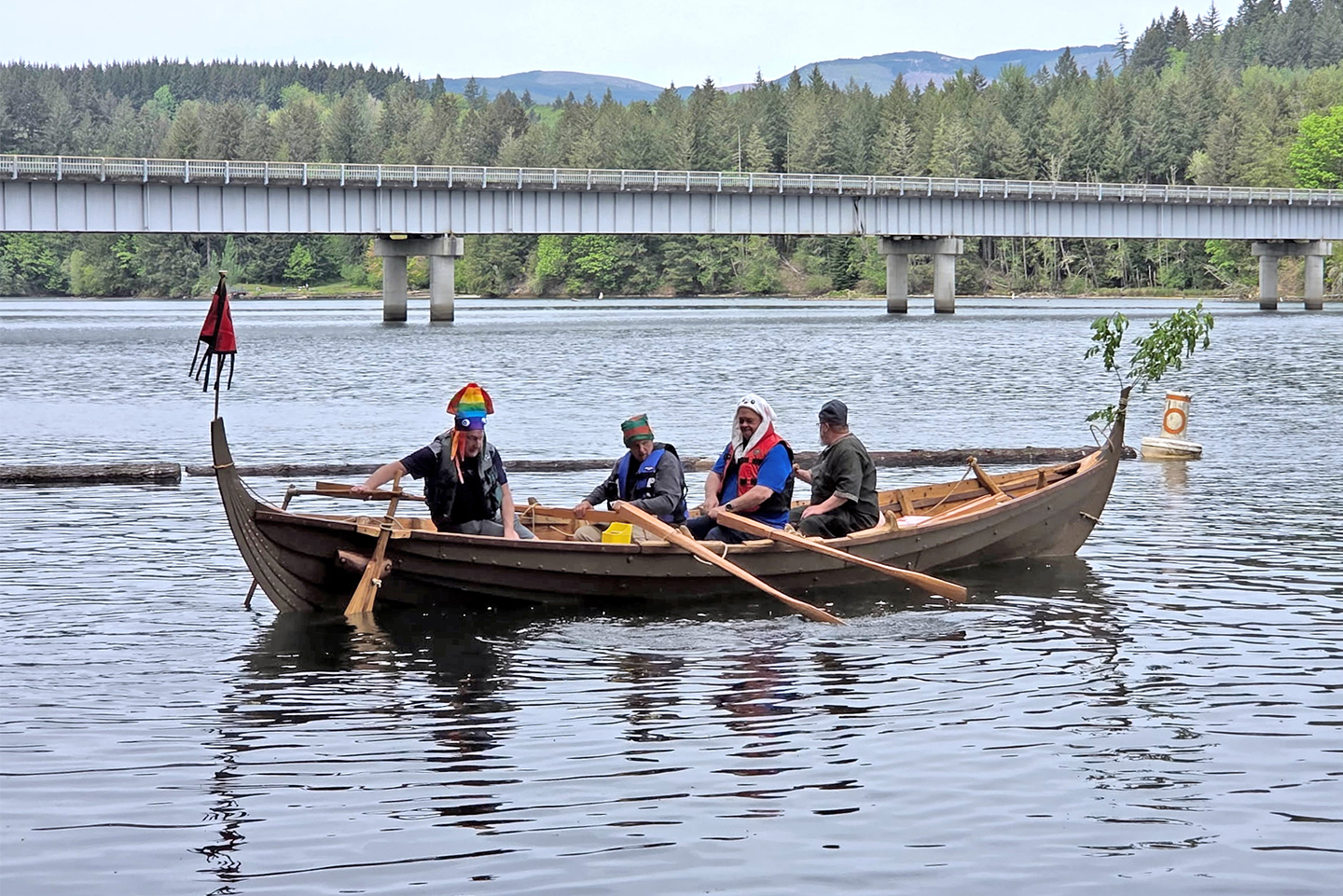
Home Port: Winlock, WA
/
Year Built: 2026
/
LOA: 26'
/
Beam:
/
Owner: Julius Strid
/
Designer: Generations of norse builders
/
Design: Gislinge III
/
Type: Row
/
All of the wood for my build is sourced from trees on our property. Our woods have douglas fir, red cedar, grand fir, white oak trees. I had a stack of second-growth cedar planks milled from a previous thinning of our trees. I used these for strakes. The keel and stems and thwarts are from blow-down douglas fir trees I cut and rived myself in the woods. The frames and oar locks are of blow-down oak trees from our property and the neighbor’s I cut out myself in the woods. The oars and mast are from a wind-throw grand fir we cut in-the-field. The steer-board and spar are cedar. I used copper fasteners to rivet the strakes. Frames are fastened using hand carved treenails. Caulking is wool from our shetland sheep and Sikaflex. I used oil paint on the exterior of the hull, the interior will be tarred and oiled. All other parts are finished with linseed oil. I’m not a museum, so I feel free to use the materials at hand and modern updates since I think the old Norse used local resources and if they had some of our modern materials they would have used them. I have modern sail material and plan to sew my own sail. Rigging will be hemp rope.
The original boat was an archeological dig by the Museum in Gislinge Denmark. They did a thorough documentation and then followed up with several reconstructions using old-norse methods. From these builds, they developed a set of plans and published open-source available to anyone that wants to build this boat. This is a larger boat than my previous built færing. This boat is about 25 feet long with a 5 foot beam. The Gislinge boat plans are at https://www.vikingeskibsmuseet.dk/en/professions/boatyard/building-projects/gislingeboat-2015/the-find/.
The Museum says the Gislinge boat was a 12th-century working boat (circa 1030AD) likely used for fishing and transporting goods and people. With a draught of just 25cm, it could ply shallow waters and waterways. At 7m long and 1.5m wide, it had a cargo capacity of around 1 ton. It had three pairs of oars and a square sail, making it flexible. At a time when travel over land was slow, small craft like the Gislinge boat were vital to coastal economies, adapting to different purposes.